The Cross as a Journey
The Stations of the Cross
for Protestant Worship
Go directly to the
Service of Worship
Dennis Bratcher
The Stations of the Cross has two related meanings. In one sense,
the Stations of the Cross refers to the liturgical practice of using
various events in the final hours of Jesus’ life as a structure for prayer
and meditation (also called the Via Crucis or Way of the Cross).
These events encompass Jesus’ journey carrying his cross from the Hall of
Pilate where he was condemned to death to the site of his execution on
Golgotha (Calvary).
As part of their acts of devotion, early Christian pilgrims to
Jerusalem retraced the route of Jesus as he carried his cross to his
death. Early pilgrimages varied considerably with different starting
places and different routes. As the practice developed in the medieval
period, the starting point for this journey through the streets of
Jerusalem began in the ruins of the Fortress of Antonia that originally
housed Pilate’s Judgment Hall, now incorporated into the Ecce Homo
Convent. It concluded at the ancient Church of the Holy Sepulcher that
marks the traditional site of Golgotha and the tomb of Jesus. By the
sixteenth century, the route this pilgrimage took through Jerusalem came
to be called the Via Dolorosa, the Way of Sorrow. Along the Way, certain
points on the journey (stations) were associated with specific events
recounted (or implied) in the Gospel accounts
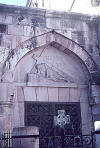 The modern practice of the Stations of the Cross was most likely
popularized in the Western church by devotional writers. This act of reverence and devotion has been preserved through the
centuries, although the actual practices associated with it have changed
considerably. Still, its
origins in pilgrimage provide the shape and content of the practice. The
Via Dolorosa and the Stations of the Cross are still a popular pilgrimage
destination in Jerusalem. Each year during Lent and especially on Good
Friday, thousands of Christians retrace the route of Jesus through the
streets of the Old City of Jerusalem, many carrying
small or large wooden crosses. The modern practice of the Stations of the Cross was most likely
popularized in the Western church by devotional writers. This act of reverence and devotion has been preserved through the
centuries, although the actual practices associated with it have changed
considerably. Still, its
origins in pilgrimage provide the shape and content of the practice. The
Via Dolorosa and the Stations of the Cross are still a popular pilgrimage
destination in Jerusalem. Each year during Lent and especially on Good
Friday, thousands of Christians retrace the route of Jesus through the
streets of the Old City of Jerusalem, many carrying
small or large wooden crosses.
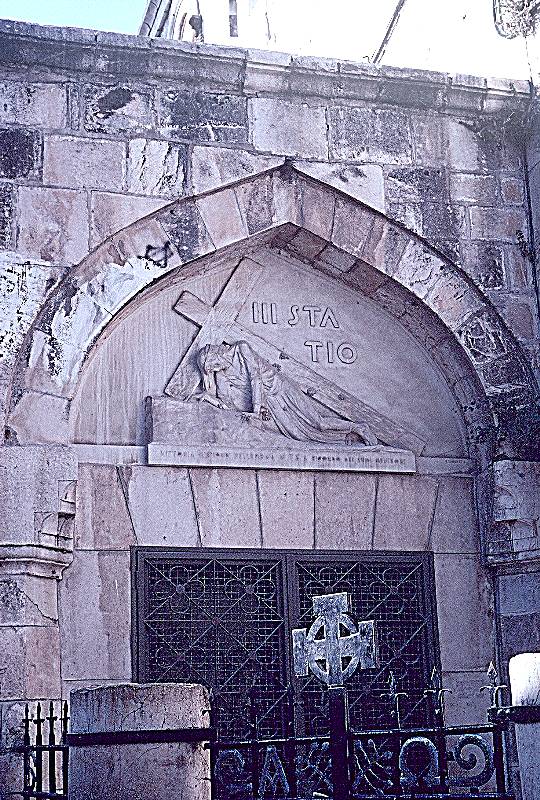
There are presently Fourteen Stations of the Cross on the Via Dolorosa,
some with chapels or places to pray and meditate.
1. Christ condemned to death;
2. the cross is laid upon him;
3. His first fall;
4. He meets His Blessed Mother;
5. Simon of Cyrene is made to bear the cross;
6. Christ's face is wiped by Veronica;
7. His second fall;
8. He meets the women of Jerusalem;
9. His third fall;
10. He is stripped of His garments;
11. His crucifixion;
12. His death on the cross;
13. His body is taken down from the cross; and
14. He is laid in the tomb.
In another sense, the Stations of the Cross refers to a series of
depictions, usually either paintings or sculpture, that coincide with the
Stations of the Cross in Jerusalem. Since many people could not make the
arduous pilgrimage to Jerusalem, in the medieval period there developed
the practice of using depictions of these Stations in local cathedrals to
allow worshippers to make the same devotional journey. They came into
general use by the seventeenth century and are present today in nearly all
Catholic churches. The popularity of the Stations of the Cross as a
devotional exercise has been fostered by these traditional depictions.
In the form of paintings or sculpted plaques, they are usually spaced
around the walls of Catholic churches, or are located in a prayer garden.
In Protestant churches that use them, they are usually located in a prayer
chapel. While historically these depictions have been paintings or
sculptures, they can be anything from banners to various kinds of art or
plaques in most any medium (for an example of wall plaques, see
Fourteen Stations of the Cross). The number of scenes (stations) in the series
can vary from eight (the events specifically mentioned in the Gospel
accounts) to fifteen (including a final Station for the resurrection).
Some of the Stations vary in different traditions.
The Significance of the Stations of the Cross
In much of the modern Western world past events are seen primarily in
terms of "happenedness," a certain action happening at a certain time and
place. Events can be described by the data-based mode of thought that
answers the questions of what, when, who, where, and how, and often only
incidentally addresses the question of why. And yet that question of why,
the question of the enduring significance of events, is usually far more
important. Especially when it comes to remembering events in terms of the
Faith, the event is not so much about the facts and the data as it is
recalling the role of that event in a larger ongoing story, in God's story
and in our own story. It is not that the "happenedness" is irrelevant. It
is more a matter of how to appropriate the event in terms of its ongoing
significance for the continuing community, for us.
Throughout Scripture, in both Old and New Testaments, God's people are
called to remember (for example, Psa 105). But they are not called to
remember events for the sake of the event. They are called to remember
because those events are part of who they are, and what they will become.
It is in this mode of remembering, of re-presenting the events of the past
as part of a living story that has not yet ended, a story in which we
still participate, that the events become more than dates and places. They
become markers of a journey as those who were no people become a people
(Ex 6:7, 1 Peter 2:10), as those who grope awkwardly in the darkness come
into the light of God's presence (Isa 9:2, John 8:12), as those who were
far off draw ever nearer to God and his grace.
The journey of our Faith as modern Christians is not only a journey
through history that can be marked by events in the past. It is also a
journey of our own personal commitment to God, of our own growth as a
community of Faith and as individuals maturing from self-centered children
into faithful servants. It is a journey that we need to remember just as
deeply and profoundly as we remember the journey of God's people across
3,000 years of human history, or the journey of Jesus from Pilate’s Hall to
Golgotha.
Most Protestants, especially in the West, are used to thinking of the
crucifixion of Jesus as an event happening at a certain time and place. Of
course, the crucifixion was such an event. But it is more than that. It is
a truth about God and how he works in the world with human beings. It is
that truth about God revealed in Jesus and his actions that provides us
with an important touchstone for our own journey.
In our eagerness to celebrate Easter and the resurrection, Protestants
often rush too quickly through Holy Week, the week between Palm Sunday and
Easter Sunday. Too much of the week, especially as it draws to an end in
Good Friday and Holy Saturday is much too messy for Christians accustomed
to the language of triumph and praise to give much attention. In doing so,
we miss the tremendous significance of the Cross as something more than a
symbol of the crucifixion and death of Jesus as prologue to the
resurrection, or as a symbol of a theological doctrine of the atonement.
As Jesus himself taught his disciples on more than one occasion, the Cross
symbolizes something far more profound than suffering and death, and
perhaps even more significant than theologies of the atonement.
Beyond all the dogmas and the sentimentalism associated with the Cross,
finally it is about faithfulness, servanthood, the commitment of One to
another that will not abandon that commitment even when rejected. In a
real sense, the cross is about the power of love, the commitment of God to
humanity, the faithfulness and grace of God that knows no limits and will
yield to no boundary, that will risk even death itself for the sake of new
life.
The journey that Jesus makes to the cross is not easy. Most such
journeys of faithfulness and servanthood are fraught with great risk.
There is suffering, and the death is real. It is not the end of the story.
But it is part of the journey. If we are to remember the cross honestly,
we must remember the entire journey, honestly. There will be a Sunday
morning, and we cannot forget that part of the story. But not yet. The
journey of the Cross winds through Holy Week, from the singing crowds on
Sunday to the darkness of Good Friday. Sunday will come. But not without
the journey through Good Friday and the Cross. The journey from Sunday
will have little meaning without the journey through Good Friday.
The Stations of the Cross is a liturgical way to reenact that journey
as a meditation of worship, an act of devotion to God. To think that the
event of Jesus’ journey to the Cross was a one time event in history is to
misunderstand the role of remembering. For in remembering this event by
walking the Stations of the Cross we are not just reenacting a 2,000 year
old event. We are making our own journey, and in the process confessing
our own dependence upon God.
Most of us, if we are honest, must confess that we do not live in the
triumph of Easter Sunday all of the time, or even most of the time. Life
simply does not work that way. No matter what victory we claim as
Christians, the realities of life are too often difficult to bear even for
people of Faith. We sometimes struggle on the journey, trying to
understand the inequities of life large and small. Sometimes we are
misjudged and misunderstood by others. We suffer physical and emotional
pain as part of being human. All too often we experience painful endings.
Marriages fail. Children make destructive decisions. Friends betray us.
Loved ones die. Sometimes the world becomes dark and hopeless, like the
world of Good Friday as Jesus journeyed to the Cross.
If we follow Jesus on his journey, we begin to understand that in
Jesus’ sufferings we see our own journey mirrored in his. Oh, we are not
likely heading to such a cruel and humiliating death. But in those somber
hours of our own "dark night" we experience similar emotions of
helplessness and sometimes hopelessness. To face such darkness we need
some glimmer of light, some hint of hope beyond endings, some model of
perseverance that comes from a faith that does not know the outcome yet is willing to trust God with it.
In Jesus’ journey to the Cross on Good Friday, we see faithfulness in
the midst of Passion (from the Greek word for "suffering"), perseverance
in the midst of endings, and courage in the midst of hopelessness. As we
trace Jesus’ journey we take up our own cross, the symbol of our own
passion, and bear the imprint of his cross in our own. But in accompanying
Jesus on the Via Dolorosa, the Way of Sorrow, we also gain courage from
his commitment to the Father in that journey, from his courage to face
what comes, and finally from the realization of the truth that with God
endings become the building blocks of new beginnings.
The value in the Stations of the Cross lies in the simple twofold
enacted confession. First, life is sometimes dark, painful, and brings
endings. That reality will not go away even for the Son of God. Second,
God does some of his best work in the darkness as we persist in the
journey, even when that journey leads to Golgotha. Resurrection Sunday has
no meaning without Good Friday. This journey reminds us of the darkness as
a basis to celebrate the light.
In this sense, we need to remember that the Stations of the Cross are
primarily a context for prayer and reflection. We can too easily go
through the motions of the service without really allowing ourselves to
encounter God. But as we open our hearts and minds to God in this symbolic
journey, we are lead to communion with God that draws us closer to His
love for us. It also allows us to identify with Jesus as he
identifies with us. We are drawn to contemplate, not only the
suffering and pain of our own journey mirrored in His, but as we follow
the Christ we are compelled to identify with those around us who suffer in
their own journey.
Protestant Devotion and the Stations of the Cross
Historically, Protestants have tended to reject the practices
associated with the Stations of the Cross, largely because they were
associated with indulgences. In the late medieval period, a certain amount
of spiritual merit, a sort of get-out-of-sin-free card, was associated
with these acts of piety. However, as the Catholic tradition has itself
changed, modern Protestants are not so much concerned with fighting the
practice. And as the pressures of a modern secular world increase, more
and more Protestants are looking for ways to reconnect with authentic and
vital piety beyond the superficial emotionalism that tends to dominate
much modern Protestant worship.
In increasing numbers, even evangelical Protestants are rediscovering
the value of liturgically shaped communal and personal devotional
practices. As a result, there has been an increasing interest from
Protestants in the Stations of the Cross, especially as part of a Good
Friday service of worship. Some churches combine the Stations of the Cross
with a
Tenebrae service, a Service of Darkness that climaxes the Services
of Holy Week before Easter Sunday. However, the Stations are used, they
can become a powerful, and for many innovative, means of worship.
Many Protestants prefer to use only eight Stations of the Cross, since
those are the main events recorded in the Gospel accounts about Jesus’ journey.
Station 1: Pilate Condemns Jesus to Die
Station 2:
Jesus Accepts His Cross
Station 3: Simon
Helps Carry the Cross
Station 4: Jesus
Speaks to the Women
Station 5: Jesus Is
Stripped of His Garments
Station 6: Jesus Is
Nailed to the Cross
Station 7: Jesus
Cares for His Mother
Station 8: Jesus
Dies on the Cross
However, some Protestants use an expanded form of the Stations to
maintain the traditional fourteen stations but still include only events
with a biblical basis. This usually requires beginning the Stations
with Jesus' prayer in Gethsemane.
1. Jesus Prays Alone
2. Jesus is Arrested
3. The Sanhedrin Tries Jesus
4. Pilate Tries Jesus
5. Pilate Condemns Jesus to Die
6. Jesus Wears the Crown of Thorns
7. Jesus Carries His Cross
8. Simon Helps Carry the Cross
9. Jesus Speaks to the Women
10. Jesus Is Nailed to the Cross
11. Criminals Speak to Jesus
12. Jesus Cares for His Mother
13. Jesus Dies on the Cross
14. Jesus is Laid in the Tomb
In most cases, especially if these are used in
connection with a
Tenebrae service, there is no mention of the Resurrection.
There will be a place for that on Sunday morning. But to preserve the
journey as a commitment to God in the darkness, the journey of the
Stations should end at the cross and the tomb.
Some Protestants might be tempted to use this solemn occasion as an
opportunity to participate in Communion. However, this is not a proper use
of Eucharist. Traditionally, for good theological reasons, Eucharist,
Thanksgiving, is not offered on Good Friday. Eucharist is not primarily a
sad occasion to remember death, but a "Thanksgiving" (which is what the
word eucharist means) for grace, a celebration of God’s salvation
and restoration. While Eucharist is often offered on Maundy Thursday
because of its association with the Last Supper and Passover, or on Easter
Sunday as a celebration of forgiveness and hope, Friday is not the time
for celebration. That moves too quickly and too easily to hope without
first confessing our hopelessness without God.
This service of worship is intended to be used as a Good Friday evening
service. It can combined with a shortened
Tenebrae service immediately
following, so that the Stations of the Cross become the meditative
introduction to Tenebrae. Or, as written here, the Service of
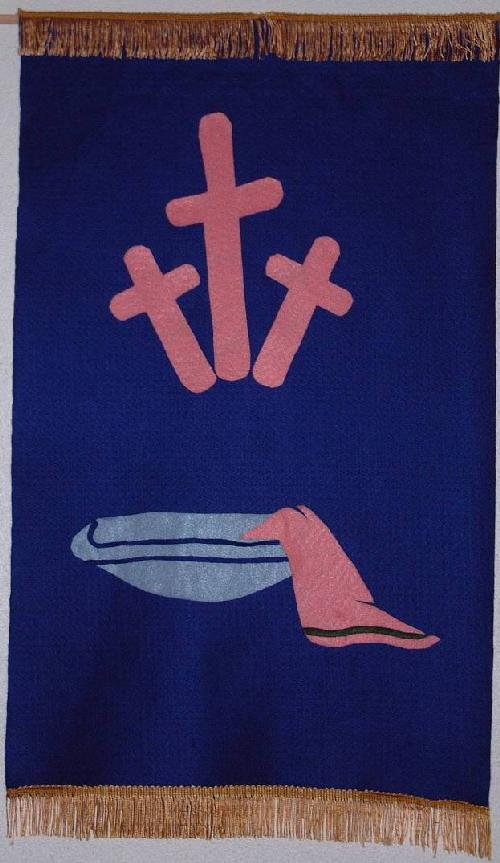
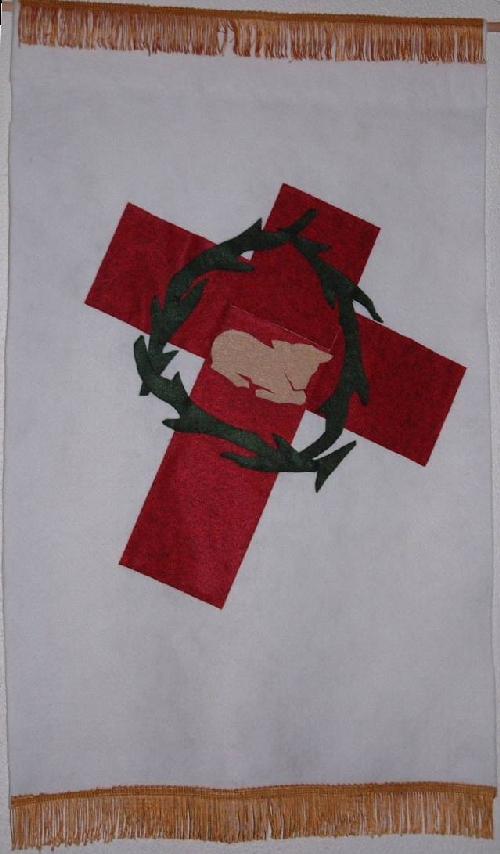
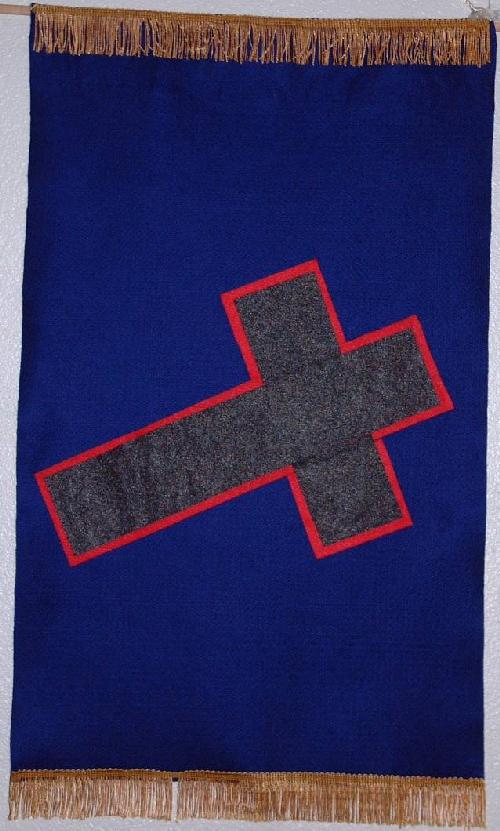
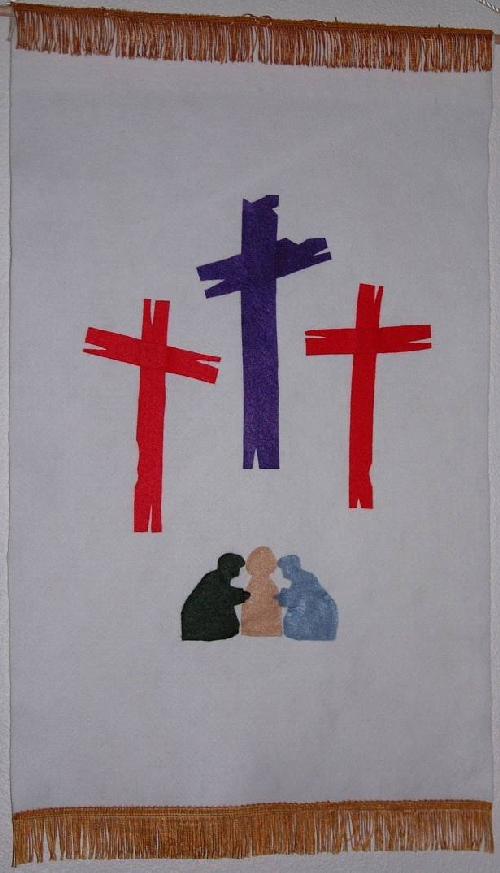
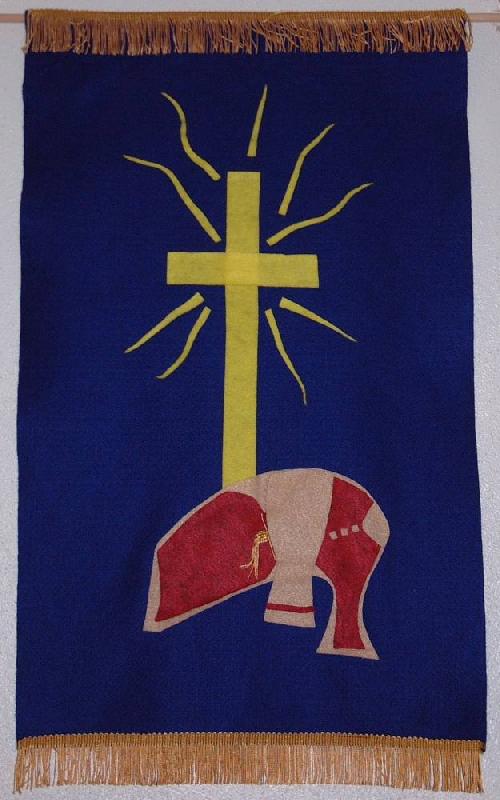
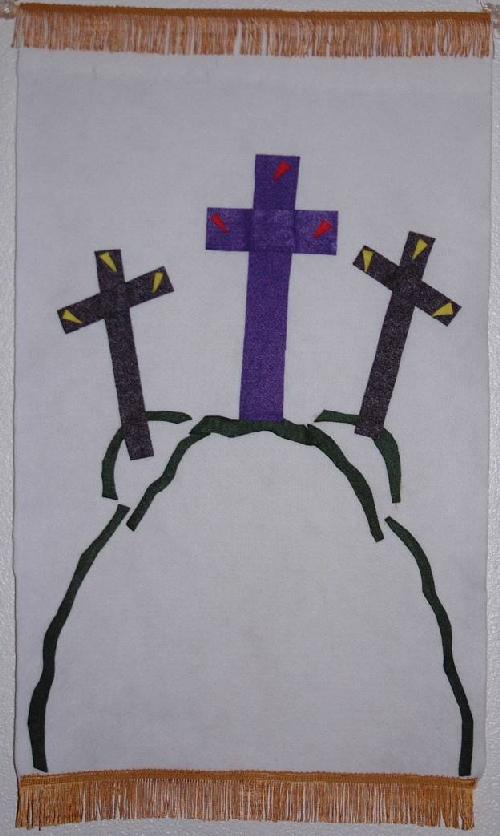
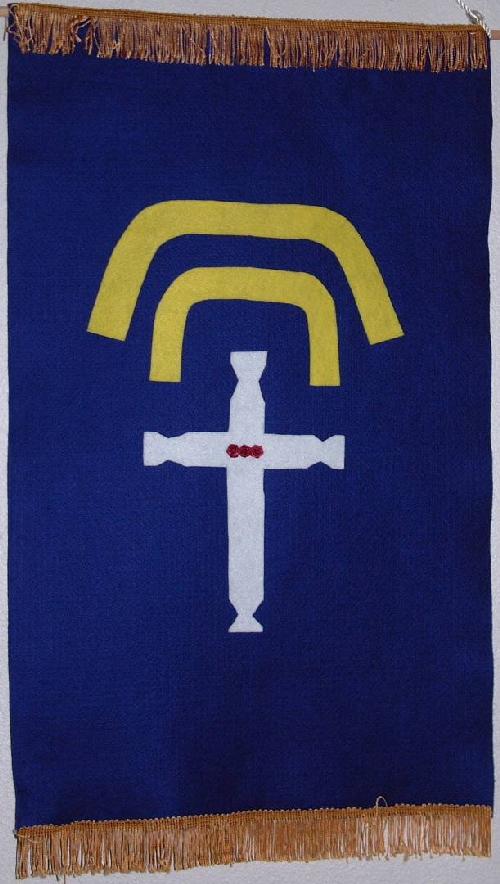
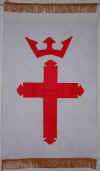
Darkness is incorporated into the sequence of the Stations. In this service, banners are used for the
Stations depicting the eight main events in the Gospels. They do not depict scenes but rather use various kinds of
crosses as symbolic of the sequence of events. The banners are hung around the sanctuary during Lent beginning
on Ash Wednesday. They can be used in the
sanctuary or moved to a large room for the Good Friday service.
The service itself is not intended to be particularly solemn, but it is
usually presented very simply and modestly. The songs are
often done a capella. For some songs, a single violin or flute can
provide an appropriate reflective interlude between the Stations.
The service should not be rushed. Leaders should not be afraid of short
times of silence to allow personal prayer and reflection.
If the service is done in a sanctuary, the banners can either be left
on the walls or presented on the platform for each Station. If the
stations are to be "walked," the service usually begins with the people seated or standing together
in the center of the room as the initial Scripture and prayers are
offered. Then as a group they move together to stand before the
various Stations as the Scriptures and meditations are read. If the group is large and the room is big enough,
there can be two or three groups moving independently to the different
stations, as long as they are done in order. In most cases, it is better
to designate someone to lead the people's readings to provide cues. The
Scripture and reflective meditation can be read by one or more readers
at each station. Usually a pastoral leader offers the prayers following
each meditation.
A powerful visual symbol for the service
is to have someone carry a large rough hewn wooden cross on their
shoulder as s/he leads the people during the entire journey of the Stations.
S/he
can wear a simple rough robe (or an alb* if it is plain)
and no shoes. Leaders can also wear plain robes or albs, but should not
wear stoles. The cross should be large enough to require some effort to
carry. While it might be tempting to enhance this visual with a crown of
thorns and simulated blood, too much visual effect begins to diminish the
power of the symbol as a focus for meditation. Most such visual symbols
communicate because they evoke reflection, not because they depict detail.
*An alb is an
ankle-length robe or tunic in white linen, sometimes roughly woven,
tied at the waist by a woven or braided white cord.
In some contexts, especially in some evangelical churches that are not
accustomed to such services, some introductory comments explaining the
purpose and flow of the service are appropriate. Or a short explanation
can be included in a worship folder.
Preparations
Decisions about how to present the readings need to be done well
ahead of the service. It is usually best to have a variety of people
present the Scripture readings and meditations, with a pastoral leader
offering the prayers. People with good reading skills should be selected
and given their assigned parts long enough ahead of time so that they
will be thoroughly familiar with the material. Emphasis should be on
reading slowly and clearly. Provide enough light at the lectern to see
easily.
All paraments and altar coverings should be removed before the start
of the service (this is usually done at the conclusion of the
Maundy
Thursday service). Any other decorations, such as flowers, should also
be removed. There should be minimal symbols on the altar, usually
only a lit Christ candle
(an altar Bible is optional).
Supplies
1. A worship folder should contain the interactive portions of the
liturgy, as well as the printed verses of songs used. While many
churches now use media in the sanctuary with display screens, this
service presents an opportunity for simplicity without the use of
too much technology. Also, media screens detract from the growing
darkness of the service. However, churches without Stations of the
Cross banners can creatively use media to display symbols of the
Stations.
2. Eight large candles in holders placed across the front of the
sanctuary. None of these should be placed on the altar/communion table.
Normally the candles are purple, but other dark colors could be used (do
not use red or white, the colors of the Church and celebration). These
should be lit immediately before the service begins, with one extinguished at
the conclusion of each Station. Alternately, multiples of eight
(16, 24) candles can be used with the appropriate number extinguished
after each Station. If the facility allows it, sanctuary lights can be
dimmed incrementally after each Station, with almost total darkness
following the last Station. After the strepitus ("great noise"),
for safety lights should be turned up slightly for people to
leave. Ushers can be provided to help those who might need
assistance in dimmed light.
3. There should be enough black cloth available to completely cover
the altar/communion table and any other visible symbols of Jesus.
Also, if it is accessible, there should be enough black cloth to
provide a lengthy drape for the sanctuary cross.
4. Material to make a loud noise. This can be two heavy pieces of
wood or two large rocks, although the clanging sound of two pieces of
heavy metal is more vivid. Often a microphone is needed to make this
loud enough. Some churches use a bell.
A Service of the Stations of the
Cross
Dennis Bratcher
Greeting (as appropriate)
Introduction
Tenebrae
(Latin for "shadows" or "darkness") is a service of worship for Good
Friday before Easter Sunday. Tenebrae is characterized by a
series of Scripture readings and meditations done in stages while lights
and/or candles are gradually extinguished to symbolize the growing
darkness not only of Jesus’ death but of hopelessness in the world
without God. The service ends in darkness with a final candle, the
Christ candle, extinguished, symbolizing the death of Jesus. The service
concludes with a loud noise (strepitus, "great noise")
symbolizing the closing of Jesus’ tomb. Worshippers then leave in
silence to wait.
This Service of Tenebrae uses the eight biblical Stations of the Cross
as a framework for the Scripture readings, meditations, and prayers. We
will follow Jesus along the Via Dolorosa, the Way of Sorrow, as
he journeys form Pilate’s Hall to his death on the cross. We enter this
journey with the penitent’s prayer, “Search me, O God, and know my
heart; test me and know my thoughts. See if there is any wicked way in
me, and lead me in the way everlasting.” (Psalm 139:23-24)
Blessing
Leader: The grace of our Lord Jesus Christ, the
love of God the father, and the Communion of the Holy Spirit be with you
all.
People: And also with you.
Scripture (Psalm 118:19-29)
Leader: Open to me the gates of righteousness,
that I may enter through them and give thanks to the LORD.
People: This is the LORD's gate; the righteous shall
enter through it.
Leader: I will give thanks because you have
answered me. You have become my salvation.
People: The stone that the builders rejected has
become the chief cornerstone.
Leader: This has come from the LORD.
People: It is marvelous in our eyes.
Leader: This is the day on which the Lord has acted.
People: Let us shout with joy and rejoice in it.
Leader: Please, save us, O LORD! Please!
People: O LORD, please bring success!
Leader: Blessed is he who comes in the name of
the LORD.
People: We bless you from the house of the
LORD.
Leader: The LORD is God
People: He has given us light. With cords bind the
festival sacrifice to the horns of the altar.
Leader: You are my God, and I will give thanks to
you.
People: You are my God, I will extol you.
Leader: O give thanks to the LORD, for he is good.
People: For his steadfast love endures
forever.
Congregational Song: Beneath the Cross of Jesus, vv. 1-2
Prayer
Leader: O Lord, we are gathered together here this day as your
people, as those who have been called out of darkness into your marvelous
light. We are here only because you have loved us and been faithful
across the generations that we might be your people. And yet we quickly
confess that we are not worthy of that love.
As we contemplate the Cross and what it means, we are
filled with joy and wonder at the sacrifice that Jesus has made to show us
light in the darkness and offer us life in the midst of death. We
confess that we have nothing to offer in return for that sacrifice,
nothing that will match such love. We know that only love can respond to
such a gift. Yet we know that we are not always loving or lovable.
But you remain steadfastly faithful to us. You love us even when we are
not lovable, and remain steadfast in your grace that calls us to follow
the example of Jesus who is the Christ.
We are committed to that journey, to be followers of
the One who has given so much that we might be sons and daughters of God.
But sometimes the journey that we take in following Jesus who is the
Christ is not all light and joy. Sometimes the Way is rough and
dimly lit. Sometimes the darkness of life threatens to engulf the
light.
And so we cry out to you, O Lord. Forgive us for our
sometimes faltering steps. Show us more clearly the Way. Shine anew the
light of your presence into our lives so strongly that a new love for You
will be kindled. Light within us a love beyond emotion and sentimentality,
a love that is willing to lay aside all privilege and self-centeredness.
Grow within us a love
that is willing to surrender all our fears and uncertainties to you, that
desires nothing more than to love God with all our being and to love those
around us with the same faithfulness with which you love us.
Now, as we begin this journey of the Cross, we open our
hearts and minds to you. We lay aside for these moments the
trivialities of our life and bring ourselves into your presence.
Speak to us what we need to hear. And help us to hear, not just the
words that are spoken, but your Word spoken afresh in our hearts.
People: Speak, for your servants are listening.
[A short time of silent prayer and
meditation]
Leader: Let us begin our journey.
The Stations of the Cross
Station 1:
Pilate Condemns Jesus to Die
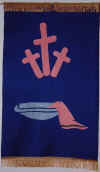
Now Jesus stood before the
governor; and the governor asked him, "Are you the King of the Jews?"
Jesus said, "You say so." But when he was accused by the chief
priests and elders, he did not answer. Then Pilate said to him, "Do
you not hear how many accusations they make against you?" But he gave him
no answer, not even to a single charge, so that the governor was greatly
amazed. . . . So when Pilate saw that he could do nothing, but rather that
a riot was beginning, he took some water and washed his hands before the
crowd, saying, "I am innocent of this man's blood; see to it yourselves."
. . . and after flogging Jesus, he handed him over to be crucified. (Matt
27:11-14, 24, 26b)
Speaker: Jesus, I wish you would speak! I wish you would proclaim who you are.
I wish you would confront the disbelief of the crowds and the arrogant
cowardice of the powers that be. Surely someone will speak up for you!
Where are the lepers who were healed? Where are the blind who can now
see? Where are all the people who ate the bread and fish on the
hillside? Where are those who followed you so easily when they thought
you would become King of the Jews? Yet no one speaks. No voice in the
crowd comes to your defense. You stand alone.
You stand before Pilate, the power of Rome. Weakness stands before
strength. And yet, Pilate, the ruthless enforcer for the Empire is not
really in control here. He cannot make you confess. He cannot quiet the
crowds. For all his power, he cannot find the courage to do what is
right. So he does what is safe. He yields to the crowds for the sake of
order. Courage and strength do not always sit on thrones or judgment
seats. Power is not always in the hands of Empires.
I have been alone. I have been falsely accused, and no one has spoken
for me. I have been treated unfairly by those who could have used their
power for better purposes. I can understand some of your feelings as you
stand silently before Pilate and watch him proclaim his own innocence as
he condemns an innocent man.
But perhaps I have treated others unfairly as well. Perhaps I have not
spoken up for others when they needed a voice. There are those around me
who have been treated unjustly. Have I always had the courage to come to
their defense? There are those around me who feel alone and abandoned.
Have I always been there for them? O Lord, forgive me for not always being
who I should be.
I find it easy to condemn the moral cowardice of Pilate. Have I ever
given in to pressure from others to take the easy path rather than the
right path? Have I ever chosen the easy path over the right path?
Leader: Jesus, I see in your silence the quiet strength that reveals a peace
and a resolve. O Lord, help me deal with the unfairness of life without
becoming critical of others. Help me to be sensitive to the pain and
feelings of others. Give me the courage to do what is right without being
swayed by the demands of others.
People: O Lord, hear our prayers.
Congregational Song: Go to Dark Gethsemane, vv. 1-2
[The first candle
is extinguished followed by a short time of silent prayer and meditation.]
Station 2:
Jesus Accepts His Cross
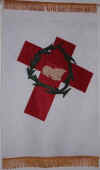
Then the soldiers of the
governor took Jesus into the governor's headquarters, and they gathered
the whole cohort around him. They stripped him and put a scarlet robe on
him, and after twisting some thorns into a crown, they put it on his head.
They put a reed in his right hand and knelt before him and mocked him,
saying, "Hail, King of the Jews!" They spat on him, and took the
reed and struck him on the head. After mocking him, they stripped
him of the robe and put his own clothes on him. Then they led him away to
crucify him. (Matthew 27:27-31)
Carrying the cross by himself, he
went out to what is called The Place of the Skull, which in Hebrew is
called Golgotha. (John 19:17)
Speaker: Jesus, I cringe at the pain of the thorns. But I am
wounded far more deeply at the humiliation and degradation you suffer,
that the very thing you came to offer us as a gift becomes a source of
ridicule. The crowds thought of a King in terms of power. But you came
to be the kind of King who shepherds his people, who takes responsibility
for their well being, whose principles are faithfulness, justice, and
righteousness (Isa 11:3-4). And yet, the people are not ready for that
kind of King.
I would like to think that I am ready to follow you
who offer a Kingdom of peace and love for one another. But am I? Am I
willing to yield my ideas of what the Kingdom should look like for the
role of a servant? Am I really so willing to give up my human
preoccupation with power and control and accept a different kind of crown
than I was expecting?
I see you accept the Cross in the midst of such
mockery. You could have refused. What more could they have done to you?
Yet you begin this journey knowing full well where it will lead. I hear
no words of complaint, no protestations of innocence, no cursing the
injustice. And yet I am so prone to complain and whine about the most
trivial things. Sometimes the things I face in my life are more than
trivial. Sometimes the troubles of life bear down on me. But I so easily
fall into self-pity. I too often assume that I am the only one who bears a
cross, or that my cross is larger and heavier than any others.
But I am not alone in that. People all around me
bear far more than I must bear. You accepted your cross without self-pity.
Can I follow your example?
Leader: O Lord, forgive me for forgetting that in my weakness I am driven to trust
on you, and that in such trust my weakness becomes your strength. Forgive
my attitudes of self-pity that make me more repulsive than loving. I do
not ask for crosses to bear. But when they come, give me the strength to
bear them as one who follows your example.
People: O Lord, be merciful to us.
Instrumental: Must Jesus Bear the Cross Alone?
[The second candle
is extinguished followed by a short time of silent prayer and meditation.]
Station 3: Simon
Helps Carry the Cross
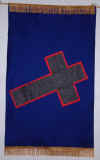
They compelled a passer-by, who
was coming in from the country, to carry his cross; it was Simon of Cyrene,
the father of Alexander and Rufus. (Mark 15:21)
Jesus, I can only imagine the awful weight of that
cross you carry. It is not just the weight of beams of wood that presses
down on you. It is also the weight of the burden you carry for those
whom you have loved. You came to offer them life, and yet they return
only death.
So I see you fall from the crushing weight of pain
and grief. I don’t know how many times you have fallen. But I know
that your physical strength is failing. The soldiers must recognize
this as well, because they force a man from the crowd to help you carry
the cross the rest of the way to the place where you will be crucified.
Perhaps they are afraid that you will die before you make it to the top
of the hill. The man of Cyrene was just a bystander passing through on
his way into town from the countryside. And yet he bears the weight of
the cross to save your strength.
I would like to think that if I had been there I
would have rushed from the crowd and volunteered to carry that cross for
you. But would I have had the courage to face the Roman soldiers and
risk being forced to join you on a cross? Would I have really been so
eager to share your cross if it meant that I might have to die on one as
well? Would I have been willing to risk everything to ease your
suffering for a few moments by letting you know that you were not alone?
Besides, I have my own crosses already. I have as
much as I can bear without taking on the added burdens of others. And
what would people think of me if I were seen consorting with criminals
and enemies of Rome in such a public spectacle? So instead of
offering to help, I tried to become invisible in the crowd. And when
the soldiers were looking around for someone to press into service, I
looked away and pretended not to notice what was happening.
It is easy to pretend not to see the needs, the
grief, and the suffering around me every day. It is easy to pretend not
to hear the cries for help that come in many forms from those among whom
I walk every day. It is easy to convince myself that I am too busy, or
too tired, or have too much on my plate already to get involved in the
lives of others. There are simply too many who need too much.
And yet, I remember something that you said,
something about taking up my own cross and following you. You said
something about becoming a servant of all, of putting myself last and
others first. Is this what it means to be a servant? Jesus, are you
showing me what it means to be that kind of servant. Is this man from
Cyrene modeling for me the path of discipleship?
Must Jesus bear the cross alone
And all the world go free?
No, there's a cross for everyone
And there's a cross for me.
Leader: O Lord, forgive me for becoming so preoccupied with
myself that I have become deaf and blind to the grief and suffering of
those around me. Forgive me for my indifference. Constantly remind me
that I cannot love you without loving others as well. Help me always
remember that to be a follower of yours means that I share in the
burdens of others. Lord, show me someone whose cross I may help carry.
People: O Lord, hear our prayers.
Congregational Song: Must Jesus Bear the Cross Alone? vv. 1, 3
[The third candle
is extinguished followed by a short time of silent prayer and meditation.]
Station 4: Jesus
Speaks to the Women
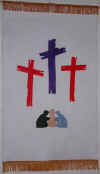
A
great number of the people followed him, and among them were women who
were beating their breasts and wailing for him. But Jesus turned to
them and said, "Daughters of Jerusalem, do not weep for me, but weep for
yourselves and for your children. For the days are surely coming
when they will say, 'Blessed are the barren, and the wombs that never
bore, and the breasts that never nursed.' Then they will begin to
say to the mountains, 'Fall on us'; and to the hills, 'Cover us.'
For if they do this when the wood is green, what will happen when it is
dry?" (Luke 23:27-31)
Jesus, as you struggle along the road toward that
awful place of death, you see a group of women among the crowd following
you, already grieving at your impending death. You have heard this
wailing many times before at funerals and tragic events. But now, they
mourn for you.
You have always shown equal compassion to women you
have encountered across the years. You have always seemed to understand
the unique burdens that women bear in a world and a culture that pushes
them to the margins of society. So here, as you bear the most
unimaginable pain of body and heart, you stop to speak to them. You are
about to die, and yet you are more concerned with others than with your
own suffering and death.
But your words are strange and seem out of place on
this road of sorrow. They have a prophetic ring to them as if you were
still trying to tell people something important that they cannot quite
grasp, or that perhaps they do not really want to hear. You speak of
even darker days, of far worse things to come upon the people. Yet, how
can things get worse?
I do remember that you often spoke of repentance,
calling the people to turn from their wicked ways and accept the coming
of the Kingdom of God. Many times you criticized the religious leaders and those
who thought themselves righteous, warning that they would bring
destruction upon the people and the land. I remember that once you even
spoke of the destruction of the temple. But no one really believes that
is going to happen. God has always been with us, and surely he will not
let such a terrible thing happen to his people.
And yet, no one thought the exile would happen.
And here you are on the path of sorrow stumbling toward your death. No
one thought that would happen either. Maybe you understand more than we
have realized. Maybe you see something that we have refused to believe.
Maybe we are not as righteous as we have thought. Maybe we have
rejected repentance, not because we did not need it but because we
needed it more than we dared admit.
Is that what you mean by these strange words? Is
it possible that your death is only the beginning of things for which to
weep? Is it possible that our refusal to repent and change the way we
live is causing these beginnings of sorrow? Is our own sin and our
refusal to confess it really the reason you are on this path?
I would like to think that I have repented, that I
have confessed my sins and stand righteous before God. I would rather
play the part of the righteous follower. I would rather weep for you,
Jesus. I do not want to weep for myself and the pain I bring to others
because of my failures and sin. Yet, how long has it been since I have
shed tears for my own failures, for my own sins? Have I really been
honest enough with God about who I am?
Leader: O Lord, forgive my unwillingness to repent, to
confess all that I am before you. Help me go beyond the repentance
mouthed in words of false piety, to sweep away all the facades of who I
try so hard to be before others, and recall who I really am inside.
Help me once again stand before God with a bare and open heart. Help me
not just to repent in words, but to put that repentance into action in
everything I am and do. O Lord, give me the gift of tears to weep for
my own failures, for my sins, for the pain I bring to others, and to live the fruits of repentance.
People: O Lord, be merciful to us.
Special Music (Audio or Solo):
Via Dolorosa
[The fourth candle
is extinguished followed by a short time of silent prayer and meditation.]
Station 5: Jesus Is
Stripped of His Garments
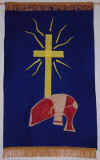
When the soldiers had crucified
Jesus, they took his clothes and divided them into four parts, one for
each soldier. They also took his tunic; now the tunic was seamless, woven
in one piece from the top. So they said to one another, "Let us not tear
it, but cast lots for it to see who will get it." This was to fulfill what
the scripture says, "They divided my clothes among themselves, and for my
clothing they cast lots." And that is what the soldiers did. (John
19:23-25a)
Jesus, I want to follow you on this journey. But I cannot watch this. I
must turn away as you are humiliated.
You came into this world amid celebration and anticipation. Angels
sang in the heavens to celebrate your birth. As a child, Magi from the
East paid homage to you as to a king. The people followed you by the
thousands as you taught on the hillsides of Galilee. They wanted to make
you king! Just a few days ago the crowds followed you in the streets of
Jerusalem singing praises to God: "Blessed is the one who comes in the
name of the Lord! "
Yet now, you are forced to suffer the worst of human indignity. You
stand alone as the soldiers strip from you the last thing that you
possess, and play games to see who will claim it.
Just yesterday, you removed your cloak and laid it aside to wash your
disciples' feet. You called them to follow your example as a symbol of
humility and service to others. Now you allow others to strip you
of your clothes. You allow them to publically disgrace and ridicule you.
You are left with nothing, not even human decency.
Are you still trying to teach us something about what it means to
serve others? Is your surrender to such degradation a model for
how we are to live in the world as your followers? I don't like
such an idea. I would rather walk with you into Jerusalem with the
praise of the people ringing in my ears than to risk such humiliation. I
want to follow you! But is this really what it means to be
a follower, that I must lay aside everything and risk this kind of
degradation? And yet, that is exactly what you are doing.
Leader: O Lord, forgive me for wanting to take the path of glory and reward.
Forgive me for my selfishness that wants to serve you in easy ways and
seeks the reward of others' praise. Lord, teach me the humility of
spirit that replaces self-centeredness with a sacrificial spirit. Make
me vulnerable so that I may follow your example. Help me see those
around me who are in need. Give me the courage to lay aside the things
that I use to hide from their need, and find ways to minister to others
as you have shown us.
People: O Lord, hear our prayers.
Instrumental:
O Love Divine, What Hast Thou Done?
[The fifth candle
is extinguished followed by a short time of silent prayer and meditation.]
Station 6: Jesus Is
Nailed to the Cross
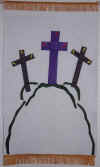
And they offered him wine mixed
with myrrh; but he did not take it. And they crucified him, and divided
his clothes among them, casting lots to decide what each should take. It
was nine o'clock in the morning when they crucified him. The inscription
of the charge against him read, "The King of the Jews." And with him they
crucified two bandits, one on his right and one on his left. Those who
passed by derided him, shaking their heads and saying, "Aha! You who would
destroy the temple and build it in three days, save yourself, and come
down from the cross!" In the same way the chief priests, along with
the scribes, were also mocking him among themselves and saying, "He saved
others; he cannot save himself. Let the Messiah, the King of Israel, come
down from the cross now, so that we may see and believe." Those who were
crucified with him also taunted him. (Mark 15:23-32)
Jesus, I do not
want to see this. Yet I force myself to watch. I hear the sharp crack
of hammer against nail and shudder.
It sounds so final. Is it over? Did all those wonderful lessons you
taught by the seaside mean anything? You spoke of being a light to the
world, but it seems that darkness is winning.
How they mock you! You said that you could rebuild the temple in three
days and I thought that anyone who can raise the dead surely could deal with
broken stones. But it is not the stones in the temple that matter to
you, is it? Your greater concern is how we relate to you and to one
another. You so want us to know the power of living love. Is love
stronger than this evil that now surrounds you?
I want to rage at the injustice of this. The cruelty of the Romans.
The hypocrisy of the High Priest and religious leaders. The cowardice
of the disciples. The treachery of Judas. The fickleness of the
crowds. Do they not remember that you spoke of loving one another, of
bearing the burdens of others, even of loving our enemies? They should
know better, they should have listened and learned.
And yet, would I have done differently? Is the guilt just of those who
drove the nails and the rest of us are innocent? Or is it human sin
that drives the nails? My sin. The old American spiritual
asks the question, "Were you there when they
crucified my Lord?" I want to deny it. I want to pretend that it is
someone else’s guilt, someone else’s sin. But I was there.
Jesus, you
are here, dying, because of my sin. I was there. It was I
who drove the nails.
Leader:
O Lord, remind me of the deathly cost of sin. Forgive me for those
things I have done that are displeasing to you. Forgive me for not
allowing you to deal with the darkness that I harbor in the hidden
recesses of my heart. Forgive me for fooling myself into believing that
I am more righteous than I am, that I am better than others, and that I
have no need to repent. Forgive me for those things I should have done,
but found excuses not to do. O Lord, make me better than I am, transform me into what I
can be by
your grace.
People: O Lord, forgive us for those things we have done and those
things we have left undone. In your grace, be merciful to us.
Special Music (Solo): Were You There? vv 1-2
[The sixth candle
is extinguished followed by a short time of silent prayer and meditation.]
Station 7: Jesus
Cares for His Mother
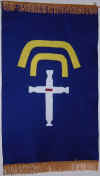
Meanwhile, standing near the cross of Jesus were his mother, and his
mother's sister, Mary the wife of Clopas, and Mary Magdalene. When Jesus
saw his mother and the disciple whom he loved standing beside her, he said
to his mother, "Woman, here is your son." Then he said to the disciple,
"Here is your mother." And from that hour the disciple took her into his
own home. (John 19:25b-27)
Jesus, these women with your mother have been with you for
much of your journey. I shouldn’t be surprised that they are surrounding
her with their love even in the midst of their own grief. Mary
Magdalene, since the day you drove away her seven demons, has never
faltered in her support. She has felt the full impact of your love. You
made her whole. And here they stand suffering with you in your suffering.
Jesus, I wonder what Mary must be thinking, feeling as she stands and
watches your life fade away hanging on that cross. Is she thinking back
to the visit of the angel who announced your coming? Is she remembering
the words of old Simeon who took you as an eight day old baby in his
arms and declared that you were God’s salvation sent for all people, a
light to the Gentiles and glory to Israel? Or is she reminded of that
day in Jerusalem when you were twelve when she searched for you and
could not find you? Finally there you were talking with the leaders of
the temple who were listening intently. You asked her, “Did you not know
I must be in my Father’s house?” Is that when your mission became clear
to Mary? Is she now wondering seeing you on that cross, “Can this be
what his Father intended for him?”
And what brought this one disciple to be standing before your cross?
The others have all run away in fear or disappointment. This disciple
could be in real danger. Besides he is standing with the women. Men just
don’t associate with women who are not from their own family. What is he
doing? Why is he here? Yet, you trust him so much that you tell him to
take care of your mother for the rest of her life. I might visit her and
bring her a meal once in a while. But to treat her like I would my own
mother is a big commitment. You ask a great deal of him. Are you asking
the same of me about other people’s mothers, fathers, sisters, brothers?
Am I willing to accept the others that God entrusts me to love?
Leader: O Lord, make me whole so that I may love with the compassion with
which you love. Give me the courage to stand beside those who
are hurting and share their pain. You know everything about me, my
weakness, my faults, and my sin. Redeem me and make me new. Through your
strength and by your grace, make me a conduit of your love, not just
to the lovable, but to any who need to be cared for and loved.
People: O Lord, hear our prayers.
Special Music (Solo): This is Love (Terry Butler and Mike
Young)
[The seventh candle
is extinguished followed by a short time of silent prayer and meditation.]
Station 8: Jesus Dies on the Cross
When it was noon, darkness came over the whole land
until three in the afternoon. At three o'clock Jesus cried out with a
loud voice, "Eloi, Eloi, lema sabachthani?" which means, "My God, my
God, why have you forsaken me?" When some of the bystanders heard it,
they said, "Listen, he is calling for Elijah." And someone ran, filled a
sponge with sour wine, put it on a stick, and gave it to him to drink,
saying, "Wait, let us see whether Elijah will come to take him down."
Then Jesus gave a loud cry and breathed his last. And the curtain of the
temple was torn in two, from top to bottom. Now when the centurion, who
stood facing him, saw that in this way he breathed his last, he said,
"Truly this man was God's Son!" (Mark 15:33-39)
It is dark in the middle of the day. It seems that the heavens and
the earth are grieving, telling us that something is horribly wrong. And
yet some still seem to mock. Or do they really expect some final miracle to save
you?
Jesus, I hear you cry out in lament from the Psalms and know that it
is the cry of human pain and desolation. Here, where too often we
see you only as God, you reveal your true humanity. Most everyone
has forsaken you, and in your pain the emotion escapes in a cry of
abandonment. Yet, it is a prayer, a cry from human lips to a God
who hears such cries.
Finally, it is over. You are dead. What have we done?
The earth shakes. The curtain in the temple is torn right down the
middle. The Holy of Holies is exposed for all to see. What does it mean?
Who are you? Even the Romans now think that you are the son of
God. But you are dead. It’s too late. What have I done?
Yet you never stopped loving me even in death. Oh, how I wish I had
shown my love for you more while you were here. You died because of
human sin, because of me. Yet we know that sin is never the final word.
God can redeem the worst that human beings can do. But this? What can
come of this? What can God do with such a final ending? We hope, and
wait . . . ..
Leader: O Lord, I cannot comprehend the depth and breadth of your love. There
are not enough words in all languages together to describe what your
love means to me. May my love for you and my love for all your children
in some way reflect your love. Let this dark night become fertile soil
for growth in your love and for our growth as a community of Faith. May
you use this night to teach us how to love you and to love others the way you
have loved us. O Lord, we long for newness, for hope, for renewal, for
life where there is now death. Out of this darkness
bring to us the light of a new dawn. O Lord, have mercy on us.
People: O Lord, hear our prayers. We hope in you and trust in your
mercy.
Congregational Song: When I Survey the Wondrous Cross, vv. 1-4
[As the song is sung, the last candle
is extinguished. As appropriate, a
black drape is placed over the sanctuary cross. Any remaining symbolic
pieces (such as an altar Bible) are removed from the altar and carried
from the sanctuary. The Christ candle is extinguished and removed
from the altar (alternatively, the lit Christ candle is removed from the
altar and carried out of the sanctuary). The altar is covered in
black cloth. Any other symbols, such as a freestanding baptismal font or
flower stands,
should also be covered in black. After the song, there is a short
time of silent prayer and meditation.]
Leader: We hope for the dawning of a new day. We hope for God to bring
newness out of endings. But today . . . . Go home. There is nothing
more to see. Jesus is dead.
A loud noise (strepitus, "great noise")
symbolizes the closing of Jesus' tomb. Worshippers are invited to remain
silently in prayer, and then leave in silence.
The banners are courtesy of Maj.
Robin Stephenson-Bratcher, retired, Chaplain, USAF
The Meditations and Prayers for Stations 1-5 are by Dennis Bratcher.
Marilynn Knott contributed to the Meditations and Prayers for Stations
6-8.
-Dennis Bratcher, Copyright ©
2018, Dennis
Bratcher, All Rights Reserved
See Copyright and User Information Notice
|